Your loan agreement is the only document that matters once the funds hit your account. The rate, the payment schedule, the late fees, the prepayment terms, the consequences of falling behind, all of it is decided right there in the paperwork the lender hands you to sign. Understanding a loan agreement before you sign is not legal advice or paranoia. It’s the only way to know what you’re actually agreeing to. The 15 minutes it takes to read carefully often saves more than the loan itself costs.
This guide walks through the agreement section by section. Every personal-loan contract has the same skeleton, even when the document looks intimidating. Once you know what to read for, you can finish a 12-page agreement in 20 minutes and ask the right questions about the parts that matter.
Federal law requires every personal-loan agreement to include a Truth in Lending Act disclosure box. It’s usually on page 1 or 2, framed by a black border, and it summarizes the entire deal in five numbers: APR, finance charge, amount financed, total of payments, and the payment schedule. If you read nothing else, read this box. Everything else in the agreement is detail and clauses around what those five numbers actually mean.
The Consumer Financial Protection Bureau’s Regulation Z, which implements TILA, sets exactly what this box has to show. That standardization is your friend, every lender’s box looks the same, so you can compare two competing offers in 60 seconds by laying their TILA boxes side by side.
If you’re looking for loan services in Utah, Mississippi, or Texas where everything is explained clearly, we can help! Our team will fully go over the terms and conditions of your loan, and answer all questions with complete transparency.
Quick take
If a lender hands you a loan agreement without a clearly framed TILA disclosure box on the first or second page, slow down and ask why. Federal law requires it. Missing or hidden TILA disclosures are a flag for predatory or non-compliant lenders, and the rest of the agreement deserves extra scrutiny.

Every loan agreement opens with a promise-to-pay clause, sometimes called the promissory note. It identifies you as the borrower, the lender by legal name, the principal amount you’re borrowing, and the total you owe back. Read the names carefully. The lender’s legal name on the agreement may differ from the brand name on the website, that’s normal, but it should match what’s on your bank statement when the funds arrive and on the company’s state license filings.
Watch for the “joint and several” language if you have a co-signer. That phrase means each of you is individually responsible for the full balance, not just half. If you default, the lender can collect 100 percent from the co-signer without first trying to collect from you. Co-signers often don’t realize this until it’s too late, so if anyone is co-signing for your loan, make sure they read this clause before they sign.
The APR is the most important single number in the agreement. It’s the all-in annual cost of borrowing, expressed as a percentage. Critically, the APR includes the interest rate plus most of the fees, origination fees, application fees, certain processing charges, blended into one annualized number. That’s why the APR is almost always higher than the simple interest rate the lender quoted in the marketing material.
The finance charge is the second number that matters. It’s the dollar total of all interest and fees you’ll pay over the life of the loan, assuming you make every payment on time and don’t pay off early. A $5,000 loan at a 28 percent APR for 36 months has a finance charge of roughly $2,460, meaning the loan costs you $7,460 total to retire $5,000 in principal.. That sticker shock is the point of the disclosure. The lender wants you to see the real cost, not just the monthly payment.
Did you know?
According to the Federal Reserve, the average commercial-bank personal-loan APR has been hovering in the high teens for prime borrowers in recent quarters, while subprime and specialty installment products run 25 to 36 percent or higher. State usury caps determine the legal maximum. APRs above the state’s cap are illegal regardless of what the agreement says.
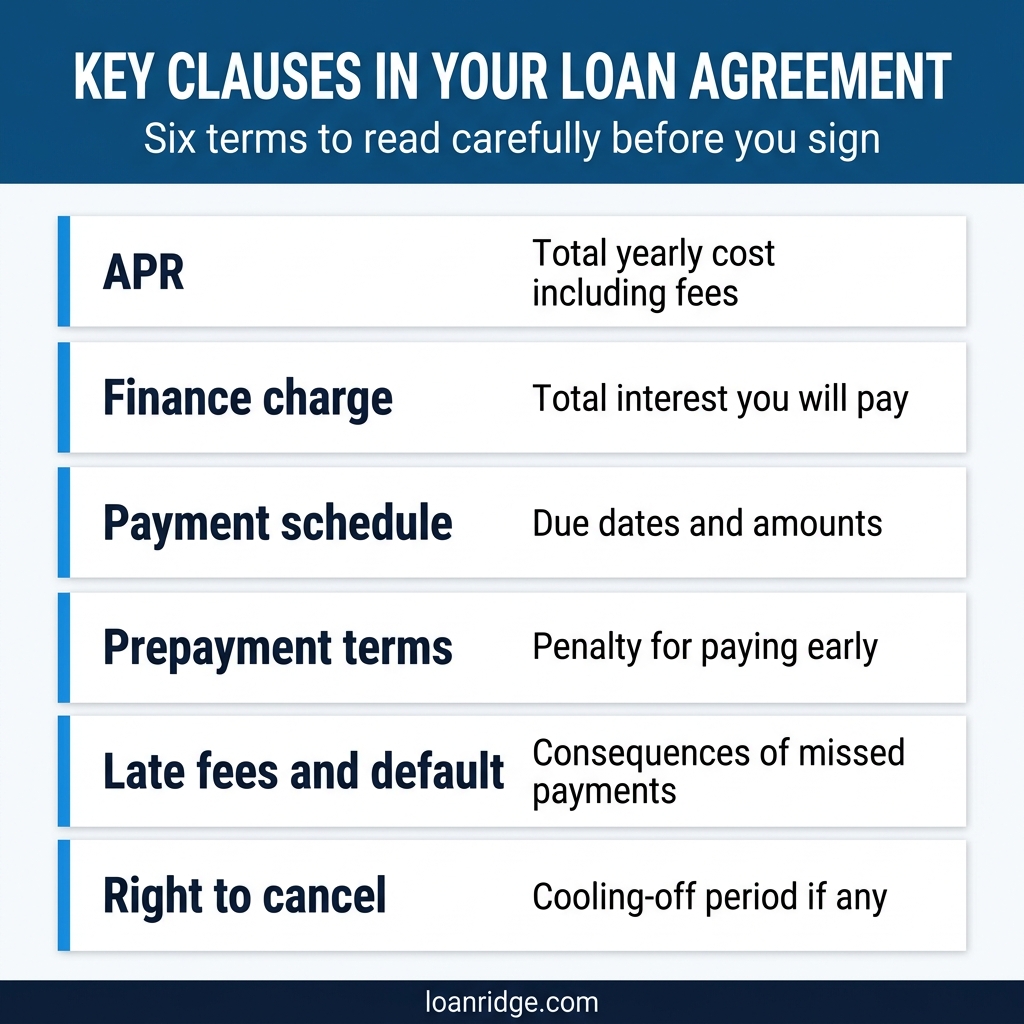
The payment schedule section gives you the exact dollar amount due each month, the day of the month it’s due, the total number of payments, and the maturity date when the loan is fully paid off. Confirm that the first payment date works for your pay cycle. A loan that auto-debits the day after rent is due is a recipe for overdraft fees. If the date is bad, ask the lender to shift it before you sign. Most will accommodate a one-time shift if you ask.
The prepayment clause tells you whether you can pay extra principal early without penalty. Federal law allows prepayment penalties on most personal loans, but in practice, well-regulated installment lenders rarely impose them. Read this clause carefully anyway. A prepayment penalty turns an aggressive payoff strategy into an expensive one, paying off a 36-month loan in 14 months saves you 22 months of interest, but a prepayment penalty can claw back several months of those savings.
Look specifically for two phrases: “no prepayment penalty” (the friendly version) and “minimum interest charge” or “rule of 78s” (the unfriendly versions, where you owe extra interest if you pay early). If you see the unfriendly versions and you might want to pay early, that’s worth a conversation with the lender or shopping the deal elsewhere.
Late fees and default terms are where the agreement actually starts to bite if life happens. Look for three things in this section: the amount of the late fee (usually a flat dollar amount or a small percentage of the missed payment, capped by state law), the grace period (how many days after the due date before the fee kicks in, typically 10 to 15 days), and the definition of default.
Default is the trigger that lets the lender accelerate the loan, demand the full balance immediately, and pursue collections. Most agreements define default as 30 to 60 days past due on a single payment, or a chain of multiple late payments. The definition matters because everything that comes next, charge-off reporting, collections, the lender’s right to sue, all of it depends on whether the technical default has been triggered.

The good news is most installment lenders prefer to keep loans current rather than default them. If you know a payment will be late, calling the lender before the due date is almost always better than calling after. Many lenders will defer or restructure a payment if you ask early. After default, the conversation becomes a collections conversation, and the borrower’s leverage drops sharply. The Consumer Financial Protection Bureau’s debt collection guidance explains your rights once an account is sent to collections.
Most personal-loan agreements include a mandatory arbitration clause. By signing, you agree that any dispute with the lender will be resolved through private arbitration rather than in court, and you waive your right to participate in a class action lawsuit. This is standard, almost every consumer financial product in the United States includes one. It’s not negotiable on a personal-loan agreement.
What you should know: arbitration is binding, arbitration decisions are extremely difficult to appeal, and the arbitration provider is usually selected by the lender. Some agreements give you a 30-day window after signing to opt out of arbitration, this is called an “opt-out clause” and it’s worth using if it exists. The instructions are usually buried in the arbitration section.
Beyond arbitration, the rights section covers how the lender can contact you (phone, text, email), how they can share or sell your information, what credit bureaus they report to, and your right to receive billing statements. The Fair Credit Reporting Act and the Fair Debt Collection Practices Act give you specific rights regardless of what the agreement says, an agreement can’t waive federal rights.
Don’t sign anything you can’t explain back to a friend in plain language. Anything in the agreement you don’t understand is something to ask about before signing. Lenders expect questions, the legitimate ones welcome them. Here are the questions worth asking out loud:
Download the Loan Agreement Reading Checklist
A printable PDF guide with every clause to review and the questions to ask before you sign.
Download free reading checklist (PDF)Disclaimer: This information is for general guidance only and is not financial, legal, or tax advice. Consult a licensed mortgage professional, financial advisor, or tax accountant before making financial decisions. LoanRidge is not liable for any outcome from actions taken based on this content.
A loan agreement isn’t designed to be a trap. It’s designed to lay out exactly what each side has agreed to, and once you know the structure, it reads quickly. Spend 20 minutes on the agreement before you sign. Highlight the APR, finance charge, payment schedule, prepayment terms, late fees, and definition of default. Ask the lender to walk you through anything you don’t understand. If the lender resists or rushes you, that’s the answer about whether to sign.
If you’re shopping a personal loan now, Loan Ridge serves borrowers in Texas, Utah, Missouri, and the Houston and Kansas City metro areas. Reach out for a soft-pull pre-qualification and an agreement you can actually read.
