The first thing a lender wants to know is whether you’ll pay them back. Everything else, the credit pull, the income proof, the bank statements, the questions about your job, all of it traces back to that one question. Once you understand what lenders look for when reviewing a loan application, the process stops feeling like a black box and starts feeling like a checklist. That shift alone can move you from rejected to approved on the same application. The fastest way to start is to take a look at our personal loans overview so you know which product fits before you apply.
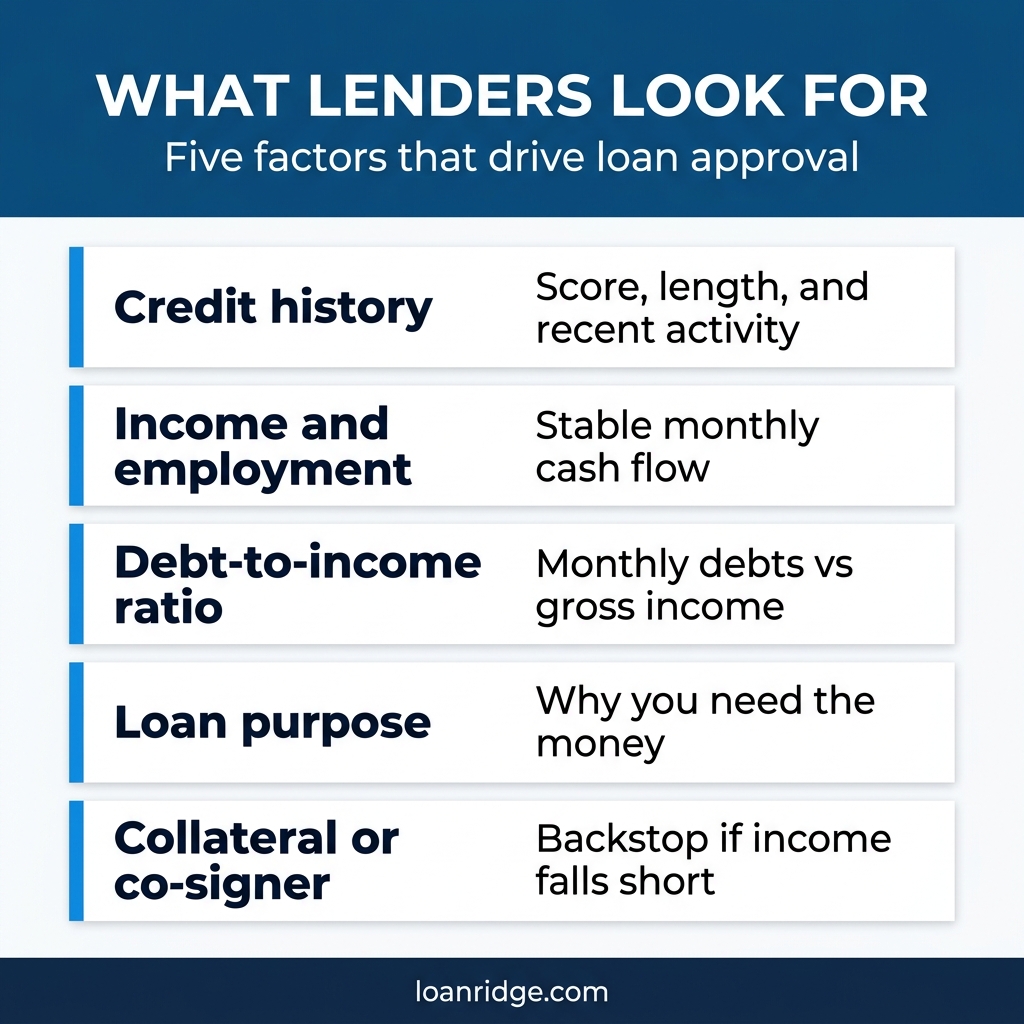
This guide walks through the five things every lender weighs, why each one matters, and what you can do this week to strengthen your application. No fluff, no fear-selling, just the actual decision tree underwriters work through.
Lending textbooks call them the five Cs of credit: character, capacity, capital, collateral, and conditions. In plain English: who you are as a borrower, whether you can afford the payments, what you’ve already saved or owe, what you can put up as backup, and what the loan is for. Banks, credit unions, and online installment-loan companies all weigh these the same way. The mix of weights shifts a little, but the questions don’t.
Here’s the thing. Most rejected applications don’t fail because the borrower was a bad bet. They fail because the application was thin in one specific area, and the lender couldn’t get comfortable with the missing piece. Knowing which area is weakest before you apply is the difference between an approval and a hard inquiry that drops your score by a few points for no result.
Did you know?
According to the Consumer Financial Protection Bureau, the average personal loan denial reason is high debt-to-income ratio, not a low credit score. Most borrowers focus on their score and never check what a lender will see when they total up the monthly debt payments next to the income.

Your credit history is the lender’s first read on whether you’re likely to repay. It’s pulled from one of the three major bureaus, Experian, Equifax, or TransUnion, and it tells a story in three parts: how long you’ve been borrowing, how reliably you’ve paid, and what you currently owe. The headline number is the credit score itself, but underwriters look beyond the score.
What they’re really watching for is patterns. A 680 score with no late payments in seven years tells a different story than a 680 score that climbed back from a 540 last year. The first one says a steady borrower. The second says a borrower who recently had trouble and is recovering. Both can get a loan, but the rate offered will look different.
Late payments in the last 24 months hurt the most. Collections, charge-offs, and bankruptcies hurt longer. The flip side is also true: on-time payments and aging accounts help. If you’ve never carried debt, you may have what’s called a thin file, which can be its own challenge. The Consumer Financial Protection Bureau’s guidance on credit scores walks through exactly what each bureau weighs.
Capacity is the lender’s word for the question, can you afford this payment every month for the next two to five years? It’s answered with three documents: recent pay stubs, the last two W-2s or 1099s, and sometimes bank statements showing the income actually hits your account. Self-employed borrowers usually need two years of tax returns instead of W-2s. The lender isn’t looking for a specific dollar amount. They’re looking for stability.
Stable means the same job or industry for at least 12 months, ideally 24. Frequent job changes don’t disqualify you, but they invite extra questions, especially if a job change came with a pay drop. Gig workers, contractors, and tipped employees can absolutely qualify, but they should expect to provide more documentation than a salaried W-2 employee, often a full year of bank statements showing deposits.
Lenders verify income two ways: by reviewing the documents you submit, and sometimes by calling your employer. Some online lenders use third-party verification services like The Work Number to confirm employment automatically. If your employer doesn’t report through that service, you may be asked for a verification of employment letter, which most HR teams can produce within a day.
Of all the loan approval factors, debt-to-income (DTI) is the one borrowers underestimate most. It’s simple math: total your monthly debt payments (minimum credit card payments, student loans, car loans, alimony, child support, the new loan you’re applying for) and divide by your gross monthly income. The result is the percentage of your income already committed to debt service.
Most personal-installment lenders cap DTI at somewhere between 40 and 50 percent including the new loan. Mortgage lenders are stricter, often capping at 36 percent. If your current DTI is already at 35 percent, the new loan payment has to fit inside the gap before you bump up against the lender’s cap.
Two things help here. First, paying down a credit card balance lowers the minimum payment counted in the DTI math, even if the card isn’t paid off. Second, lengthening the loan term lowers the monthly payment, which lowers the impact on your DTI. The trade-off is a higher total interest cost over the life of the loan. Run both numbers before deciding.

People often ask: how is my DTI calculated if I’m self-employed?
Lenders use net business income from your tax returns, averaged over two years, divided by 12 months. Add-backs for depreciation are sometimes allowed. If your business income spiked the most recent year, expect the lender to use the lower two-year average rather than the higher single year. That conservative read is normal and not negotiable on most products.
Lenders want to know why you need the money. The reason matters less than the consistency between the reason and the amount. A request for $5,000 for medical bills reads as reasonable. A request for $25,000 for an unspecified purpose with no documentation reads as a risk, even if your credit and income are strong.
Common acceptable purposes for a personal installment loan include debt consolidation, medical or dental expenses, home or auto repairs, moving costs, or unexpected emergencies. The installment loan basics page goes into how the structure differs from a revolving credit card or a line of credit. Some uses are restricted by lender policy, gambling, securities trading, or business expenses are common exclusions.
The amount itself matters because it’s evaluated against your income and existing debt. A general benchmark: most online installment lenders are comfortable with a loan amount equal to 50 to 100 percent of your gross monthly income for prime borrowers, less for thinner files. Asking for the maximum the lender will offer is rarely the right move. Asking for what you actually need, with documentation showing what the money is for, is.
Most personal installment loans are unsecured, meaning no collateral is required. The lender’s only recourse if you stop paying is to send the account to collections, sue you, or report the default to the credit bureaus. They price unsecured loans accordingly, the rate is higher than a secured product because the lender’s risk is higher.
Collateral comes into play when the loan is secured. A car-title loan is secured by the vehicle. A home equity loan is secured by the house. Some banks and credit unions offer share-secured personal loans backed by money in a savings account. If you have an asset you’re willing to pledge, a secured loan typically comes with a lower rate and easier approval, with the obvious downside that the asset is at risk if you default.
A co-signer is the other backstop. When a co-signer joins your application, the lender uses both incomes and credit profiles to evaluate the loan, and both of you are equally on the hook for repayment. Co-signers are common for first-time borrowers, students, or anyone with thin credit who has access to a parent or family member with strong credit. The co-signer’s credit takes a hit if you miss payments, so the conversation needs to be honest before either of you signs.
People often ask: do I need a co-signer if I have no credit?
Not always. Some lenders, including specialty installment lenders, will work with thin or no credit if your income and DTI are strong and the loan amount is modest. The trade-off is a higher rate. A co-signer can lower the rate but isn’t required everywhere.
The week before you apply, run this short list. Each one tightens your application, and most cost nothing.
Download the Loan Approval Checklist
A printable PDF with everything a lender will ask for and how to organize it before you apply.
Disclaimer: This information is for general guidance only and is not financial, legal, or tax advice. Consult a licensed mortgage professional, financial advisor, or tax accountant before making financial decisions. LoanRidge is not liable for any outcome from actions taken based on this content.
Lenders are weighing five things at the same time, and the strongest application is the one with no obvious weak spot. Credit history shows your repayment track record. Income and employment show that you can pay. DTI shows whether you have room in the budget. The loan purpose and amount show consistency between what you need and what you’re asking for. Collateral or a co-signer is the backup if the rest is borderline. Walk in with all five reasonable, and approval becomes a paperwork question, not a guessing game.
If you’d like to see what you’d qualify for without affecting your credit score, you can start a soft pre-qualification through LoanRidge in a few minutes. We serve borrowers in Texas, Utah, and Missouri.
