You probably know that paying bills on time builds credit. But can a personal installment loan actually improve your credit score? The short answer is yes, under the right conditions. The longer answer involves understanding how the credit system works and what questions to ask before you borrow.
This guide explains how an installment loan affects your credit report, what lenders actually look for, and the fastest realistic path from no credit or bad credit to a score that opens better options.

The FICO score, used by most lenders, is built from five factors:
An installment loan directly affects payment history, credit mix, and length of history. Three of five factors. That is why a well-managed installment loan can move your score.
Borrowers with no credit history at all (“credit invisible”) can see their FICO score go from 0 to over 600 within 12 months of on-time installment loan payments, according to data from the Consumer Financial Protection Bureau.
Two things matter more than the loan amount or term.
Equifax, Experian, and TransUnion are the three major credit bureaus. For a loan to help your score, the installment loan lender must report your payment activity to one or more of them. Not all lenders do this, especially in the bad-credit and no-credit-check space. Always ask before you apply.
This sounds obvious but it matters to say it clearly. One 30-day late payment stays on your credit report for 7 years and can drop your score by 50 to 100 points. Building credit with a loan only works if you make every payment on time. Set up autopay if your bank offers it.
A hard credit inquiry from a loan application typically lowers your score by 2 to 5 points temporarily. This impact fades within a few months. The more important factor is whether you manage the loan well after approval. One inquiry has far less impact than 12 months of on-time payments have on building your score.
Many bad-credit and no-credit-check lenders do NOT report to credit bureaus. This makes business sense for them: a borrower who builds good credit will eventually qualify for cheaper loans elsewhere. So ask directly before applying.
Questions to ask any lender:
If a lender says they only report negative payment history (missed payments) but not positive payments, the loan can hurt your credit if you are late, but it cannot help you if you pay on time. That is a one-sided deal. Move on.

Credit-builder loans are specifically designed to build credit. A credit union or community bank holds your loan funds in a savings account while you make payments. At the end of the term, you receive the money. The lender reports every payment to the bureaus.
These are low-risk for the lender (they hold the money as collateral) so they are accessible even with no credit history. Credit unions and some CDFIs (Community Development Financial Institutions) offer them. Terms are usually 12 to 24 months, amounts $300 to $1,000.
A credit-builder loan will not get you $1,000 in cash right now. But if your goal is building credit rather than covering an emergency, it is a more efficient tool.
| Timeframe | What typically happens to your score |
|---|---|
| Month 1 | Score may dip slightly from hard inquiry at application |
| Months 2 to 4 | First on-time payments appear; minor improvement begins |
| Months 5 to 8 | Consistent on-time history starts to lift score 20 to 40 points |
| Months 9 to 12 | Strong improvement, 40 to 80 points possible from starting baseline |
| After payoff | Account shows as paid/closed; positive history remains for up to 10 years |
These figures assume no other negative activity (late payments, collections, new debt) during the same period. Credit scores are not a single-variable system. Paying your loan on time while carrying high credit card balances will still drag your score.
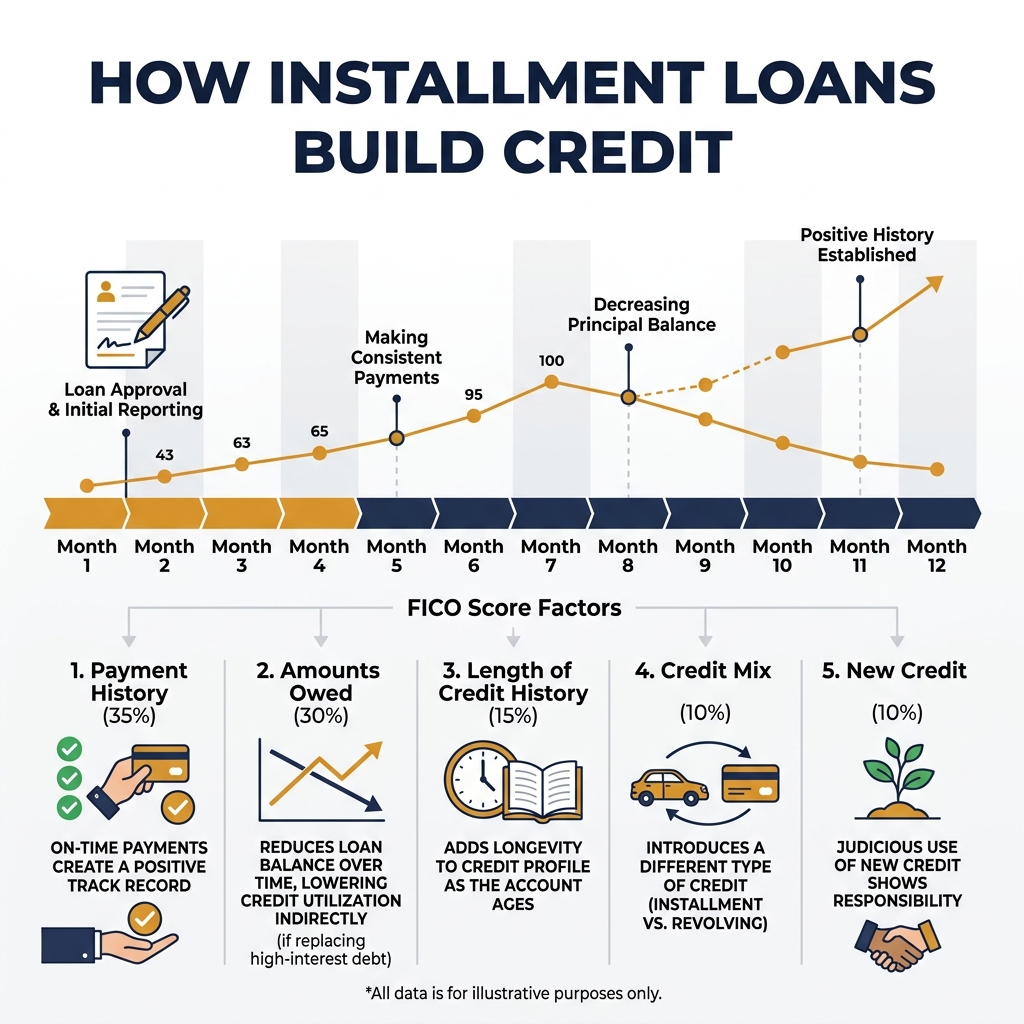
A personal installment loan can be a useful credit-building tool, but only if the lender reports your payments and you consistently pay on time. The loan itself does not improve your score automatically, your payment history does. Before borrowing, verify which credit bureaus the lender reports to, understand the repayment terms, and borrow only what you can comfortably afford. When managed responsibly, an installment loan can help establish a stronger credit profile and open the door to better financial opportunities over time.
Only if the lender reports to at least one major credit bureau. ‘No credit check’ refers to how the lender evaluates your application, not whether they report your payments. Ask the lender directly before applying.
It depends on your starting point. Someone with no credit at all can go from ‘no score’ to 580 to 620 within 12 months. Someone with existing bad credit may see a 40 to 60 point improvement after a year of on-time payments, assuming no other negative activity.
No. A paid-off installment loan stays on your credit report as a positive closed account for up to 10 years. It contributes to your length of credit history and shows a completed repayment record.
