People with bad credit or no credit history are the most targeted group for loan fraud. Before submitting any application, you need to know how to verify whether a lender is legitimate. This checklist takes about five minutes and can save you your banking information, your personal data, and real money.
These eight checks work for any lender, whether you found them through a search engine, a social media ad, or a recommendation from someone you know.

Scammers know that someone with bad credit has been rejected elsewhere. That rejection creates desperation, which makes people less likely to ask questions. A fake lender promising fast approval with no credit check can seem like a lifeline.
The pitch is usually the same, easy approval, funds within hours, minimal requirements. The reality is that once you share your Social Security number, bank account details, or send an upfront fee, the scammer disappears. The CFPB reports that loan fraud losses run into the billions annually.
Go to nmlsconsumeraccess.org and search for the lender by name or NMLS ID. This registry lists licensed mortgage and consumer lending companies. If your lender is not there, that does not automatically mean fraud (some state-licensed lenders use different registries), but it warrants more scrutiny.
Contact your state financial regulator directly and ask if the lender holds an active license. Texas, Missouri, and Utah each have public license lookup tools online. See the state licensing section below for direct links.
Search the address on Google Maps. Does a real office building appear? If the address resolves to a strip mall in an unrelated business, a private home, or nothing at all, be very cautious. Fake lenders often use virtual office services that provide an address with no real presence.
Call before you apply. A real lender’s phone line is answered by a person who can explain the loan products, tell you the APR range, and describe the application process. If no one answers, or the number is a voicemail with no callback, stop.
Legitimate lenders let you review the full loan agreement, including the APR, repayment schedule, and fee list, before you commit. If a lender refuses to show you terms until after you submit your personal information, that is a problem.
The website should use HTTPS (look for the padlock icon in the browser address bar). There should also be a real, readable privacy policy explaining how your data is used. A missing privacy policy or one that is clearly copied boilerplate with placeholder text suggests an untrustworthy operation.
Search “lender name + BBB” and “lender name + complaint.” The Better Business Bureau at bbb.org aggregates complaints. Also check the CFPB complaint database at consumerfinance.gov/complaint. Multiple recent complaints about the same issue are a warning sign.
Use a free WHOIS lookup (e.g., whois.domaintools.com) to see when the lender’s domain was registered. Scam sites are often less than 6 months old. An established lender has typically held their domain for several years.

Each state provides a public tool to verify lender licenses:
At Loan Ridge, we are licensed to provide loans in Texas, Missouri, and Utah!
Texas has one of the most complex lending regulatory systems in the US. Lenders can operate as regulated lenders (Chapter 342), as credit access businesses (Chapter 393), or as both. Each carries different consumer protections. If you’re unsure which type your lender is, call the OCCC directly at 800-538-1579.
Stop the process and do not share more information if you see any of these:
Save your state regulator’s phone number in your contacts before applying for any loan: Texas OCCC: 800-538-1579 | Missouri Division of Finance: 573-751-3242 | Utah DFI: 801-538-8830.
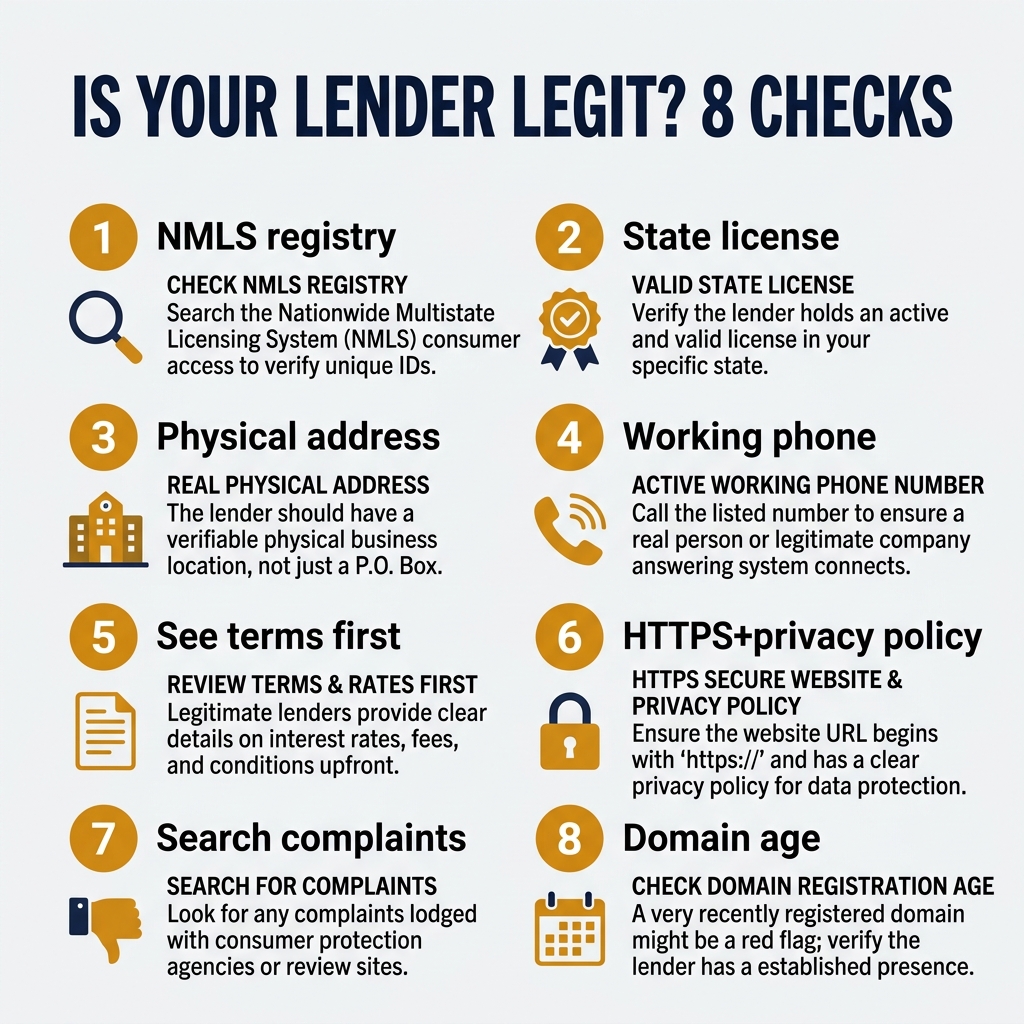
Loan scams rely on speed and confusion. This checklist helps you slow down and verify before you share anything important. A legitimate lender will always be transparent about licensing, terms, and contact details. If something doesn’t check out, stop and confirm through official sources. Taking a few minutes to verify can protect your identity, your bank account, and your peace of mind.
Licensing means the lender has met state registration requirements. It does not guarantee fair practices. A licensed lender can still use aggressive terms or confusing contracts. The checklist above covers both legal and ethical red flags.
Do not give your full Social Security number, bank account number, or debit card information until you have verified the lender is licensed and you have reviewed the loan agreement. A lender who asks for this information before showing you any terms is a red flag.
It depends on how you paid. Bank wire transfers and gift cards are usually unrecoverable. If you paid by debit card, contact your bank about a dispute. Report the fraud to the FTC and your state attorney general regardless.
Loan Ridge is a loan-matching platform that connects borrowers with licensed lenders. Our network lenders hold active licenses in Texas, Missouri, and Utah. You can review lender details before accepting any offer.
If this is relevant to something you are dealing with right now, these Loan Ridge pages go into the detail:
Loan Ridge lends to residents of Texas, Missouri and Utah only, up to $2,000. Rates, fees and terms vary by state and are disclosed before you accept any loan. Approval is not guaranteed.
