Here is the question that trips up a lot of borrowers: “do no credit check loans” show up on a credit report? The honest answer is, it depends on the lender, not on the words “no credit check.” Skipping the hard inquiry when you apply is one thing, whether the loan and your payments get reported afterward is a completely separate decision the lender makes. Understanding that difference helps you borrow smarter.
In this guide we will clear up the myth, explain what this loan really is, walk through what does and does not land on your report, and show how to use that knowledge to protect, or even build, your credit.
Financial disclaimer: This article is for general information only and is not financial, legal, or tax advice. Loan Ridge is a CAB in Texas, not a lender, law firm, or credit-counseling agency. Laws, lender terms, and credit-reporting practices change and vary by state. Before you act on anything here, consult a licensed financial advisor, a nonprofit credit counselor, or a licensed attorney about your own situation.
It’s exactly what it sounds like at the application stage, the lender decides whether to approve you without pulling a traditional hard credit check from the major bureaus. Instead, they may look at income, employment, bank activity, or other signals to gauge whether you can repay.
That approach can help if you have thin credit, past credit problems, or simply no history yet. But “no credit check” describes the approval step only. It says nothing about what the lender does with your account afterward, and that is where the credit-report question actually lives.
This is just one of the many loan services we offer in Texas, so if you’re unsure if this is the right one for you, give our expert team a call and we’ll be able to help you out!
The three nationwide credit bureaus, Equifax, Experian, and TransUnion, each maintain a separate file on you. Additionally, many short-term or ‘no credit check’ lenders report to alternative subprime bureaus like Clarity Services or FactorTrust instead of the big three. This means your loan might still be visible to other alternative lenders even if it doesn’t show up on your main FICO file.Lenders are not required to report to any of them, and some report to one, two, all three, or none. That is why the same loan can appear on one of your reports and be invisible on another.
To answer the headline question, you first need two terms. A hard inquiry happens when a lender checks your credit to make a lending decision, it can show on your report and may nudge your score down slightly for a while. A soft inquiry, such as checking your own credit or a prequalification, does not affect your score.
A true no credit check loan generally avoids the hard inquiry at application, so the act of applying usually will not ding your score. The Consumer Financial Protection Bureau explains how inquiries and other items appear in your file in its overview of credit reports and scores. The key takeaway, avoiding the inquiry is not the same as avoiding the report.
Before you accept any loan, ask the lender directly: “Do you report this loan and my payments to the credit bureaus, and to which ones?” The answer tells you two things at once, whether on-time payments can help your credit and whether a missed payment can hurt it. A reputable lender will answer plainly. If they dodge the question, treat that as a reason to slow down and verify the lender.

Sometimes yes, sometimes no. Because reporting is the lender’s choice, a no credit check loan may or may not appear on your credit report once it is open. Here is the practical breakdown:
It can go either way. While you pay on time, a reported loan may help your score by adding positive history, and an unreported loan has no effect at all. The risk is on the downside: if you fall behind, a reported late payment or a collection account from default can lower your score and stay on your file for years. So the loan does not automatically affect your score; how it is reported and how you repay it do.
This is the scenario borrowers underestimate most. A loan that was invisible while you paid on time can become very visible if you default. When an account goes unpaid, the lender may report the delinquency (if it reports at all) or sell the debt to a collector, and collection accounts routinely land on credit reports.

According to the Consumer Financial Protection Bureau, most negative information, including collection accounts, generally remains on your credit reports for about seven years. If you are worried about falling behind, our guide on what happens if you cannot repay a loan covers the steps to take before a small problem becomes a collection account.
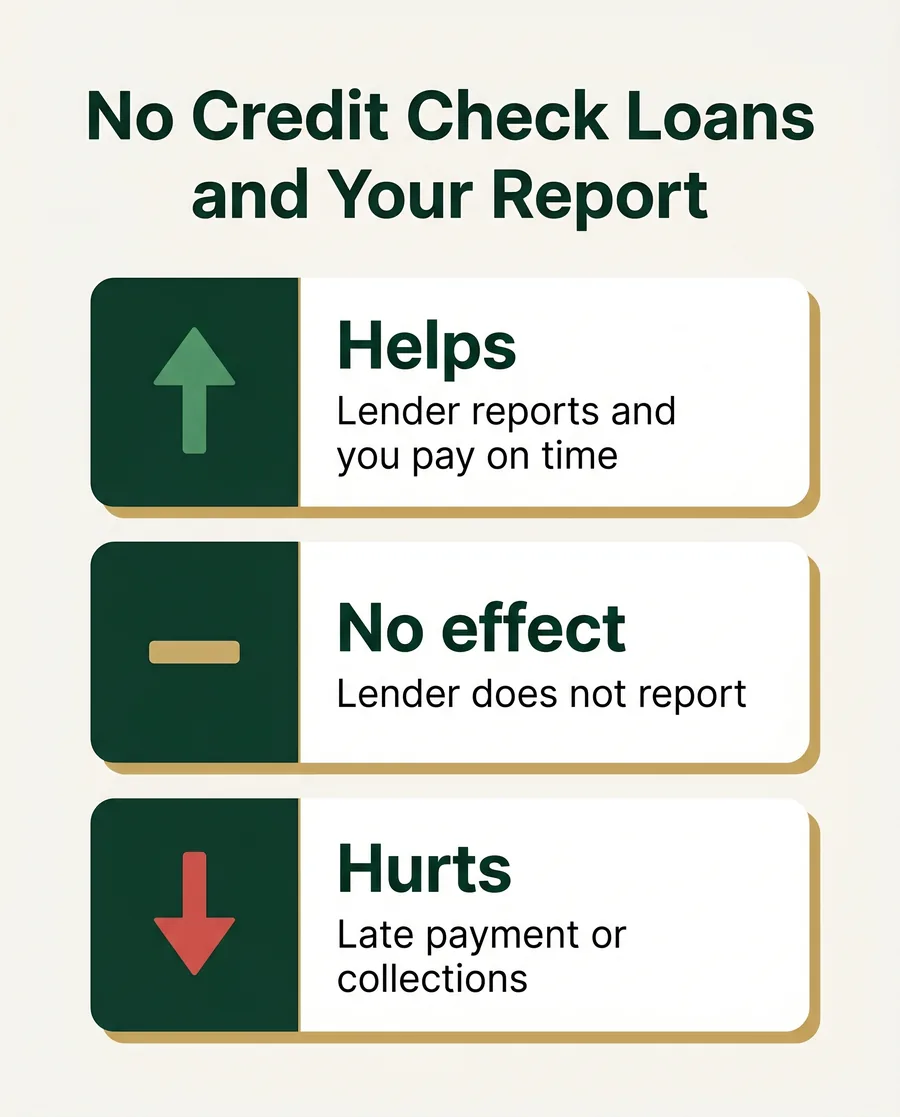
Yes, but only if two things are true, the lender reports your payments to at least one bureau, and you pay on time. Positive payment history is one of the biggest building blocks of a credit score, so a reported loan you repay responsibly can help you establish or rebuild credit over time. An unreported loan, by contrast, will not build credit no matter how perfectly you pay it. If credit building is your goal, focus on lenders that report and pair the loan with steady on-time payments.
| Situation | Shows on report? | Effect on credit |
|---|---|---|
| Lender reports, you pay on time | Yes | Can help build positive history |
| Lender reports, you pay late | Yes | Can lower your score |
| Lender does not report, you pay on time | No | No effect while active |
| You default and debt goes to collections | Yes, as a collection | Can lower your score for years |
You never have to guess what a lender reported. You can see it for yourself, for free, and you should check periodically.
Sources and further reading
They might, and they might not. The phrase no credit check refers only to the application step, meaning the lender approves you without a hard inquiry. Whether the loan then appears on your credit report depends on whether that lender reports to the bureaus, which is entirely their choice. Some report to one or more of Equifax, Experian, and TransUnion, and some report to none. The clearest way to know is to ask the lender directly before you sign and then verify by pulling your own reports from AnnualCreditReport.com a month or two after the loan opens.
Usually not at the application stage. A genuine no credit check loan avoids the hard inquiry that a traditional loan application triggers, and it is the hard inquiry that can temporarily lower your score. Checking your own credit or getting prequalified is a soft inquiry, which does not affect your score. The bigger risk to your score comes later: if the lender reports the account and you pay late, or if you default and the debt goes to collections. So the application itself rarely hurts, but how you repay can.
Yes. Even when a lender keeps an active, on-time loan off your reports, a default can change that. If you stop paying, the lender may report the delinquency or sell the debt to a collection agency, and collection accounts are routinely reported to the bureaus. The Consumer Financial Protection Bureau notes that most negative information, including collections, generally stays on your reports for about seven years. So an unreported loan is not a guarantee of permanent invisibility; falling behind is the most common way it suddenly shows up.
Pull your credit reports and read them. The official, free source is AnnualCreditReport.com, which lets you request reports from all three nationwide bureaus. Because lenders report selectively, check Equifax, Experian, and TransUnion individually, since a loan may show on one and not the others. Review each account for an accurate balance, status, and payment history. If you spot something wrong, you have the right to dispute it with both the credit bureau and the lender. Checking a few times a year helps you catch errors and track your progress.
A no credit check loan is not automatically invisible to the credit bureaus. Whether it appears on your credit report depends entirely on the lender’s reporting practices and how the loan is managed after approval. Before borrowing, take the time to ask whether payments are reported and to which bureaus. That single question can tell you whether the loan has the potential to help build credit, have no impact at all, or create negative marks if payments are missed. Understanding the difference helps you borrow with confidence and avoid surprises later.
LoanRidge is a loan-matching service for borrowers in Texas, Missouri, and Utah, not a lender or a credit bureau. See how the process works, browse the FAQ, or reach out with a question. For guidance on your specific credit situation, please speak with a licensed financial advisor or a nonprofit credit counselor.
