If you live in Texas and need a personal loan, the rules protecting you are not the same as in other states. Understanding Texas personal loan laws helps you know what lenders can legally charge, what they must disclose, and where to turn if something goes wrong.
Texas has its own regulatory agency for consumer lending, its own fee caps for certain loan types, and specific disclosure requirements. Here is what every Texas borrower should know before applying.

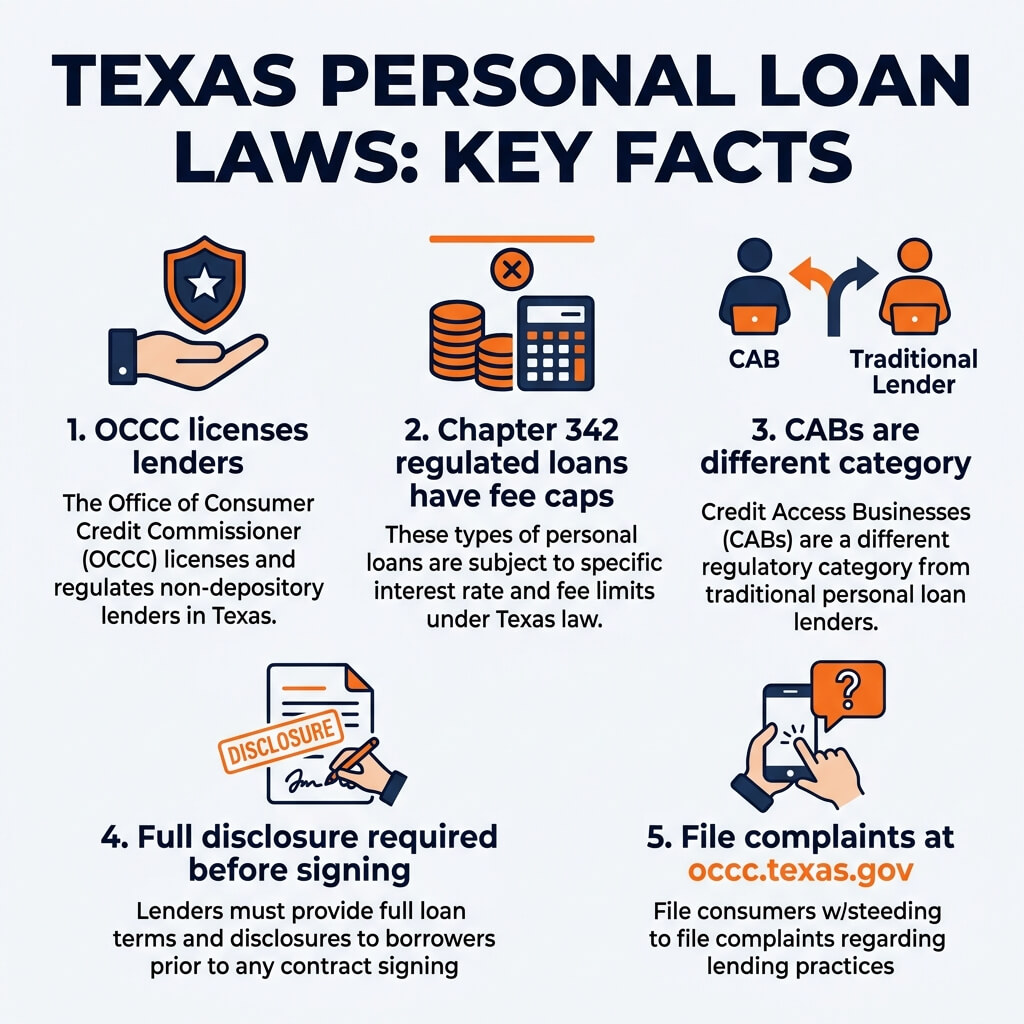
The Texas Office of Consumer Credit Commissioner (OCCC) is the state agency that licenses and regulates consumer lenders in Texas. If a lender offers personal loans in Texas, they must hold an active OCCC license unless they are a federally chartered bank or credit union.
The OCCC licenses several types of consumer lenders. The ones most relevant to personal loan borrowers are regulated lenders under Texas Finance Code Chapter 342 and credit access businesses (CABs) under Chapter 393. Each type operates under different rules.
The OCCC handled over 1,800 consumer complaints in a recent year. The most common issues involved unauthorized charges, unclear loan terms, and collection practices.
A Chapter 342 regulated lender makes direct loans to consumers. These lenders must follow Texas’s interest rate and fee caps, provide written disclosure of all loan terms before you sign, and hold an active OCCC license. Most installment loan companies that operate in Texas fall under this category.
A credit access business (CAB) arranges loans from third-party lenders rather than lending its own money. CABs are common in the payday and auto title loan space. They charge a fee for their service on top of the lender’s interest. Texas does not cap the total fees a CAB can charge, which is why some short-term loan costs in Texas can be extremely high.
If you are applying through a loan-matching service, make sure you understand whether you are dealing with a regulated lender or a CAB arrangement.
For Chapter 342 regulated loans, Texas sets maximum interest rates based on the loan amount and term. The rules are detailed, but the key point is that regulated consumer loans have legal caps. For example, loans up to $2,010 may not exceed certain monthly rates set in the Finance Code.
CAB-arranged payday and auto title loans, however, are not subject to the same interest rate caps, which is why their effective APRs can reach 400% or more in Texas. Several Texas cities including Austin, Dallas, Houston, and San Antonio have passed local ordinances placing additional restrictions on payday loans within city limits.

Under federal Truth in Lending Act (TILA) and Texas Finance Code requirements, licensed lenders must give you a written disclosure before you sign that includes:
If a lender in Texas cannot or will not provide these disclosures in writing before you sign, they are violating both federal and state law. You can report them to the OCCC.
If you believe a lender has violated Texas lending law, you can file a complaint with the OCCC at occc.texas.gov/consumers or by calling 800-538-1579. The OCCC investigates complaints against licensed lenders and can take enforcement action including revoking licenses and issuing fines.
You can also file a federal complaint with the Consumer Financial Protection Bureau at consumerfinance.gov/complaint. Federal complaints often get forwarded to state agencies as well.
Before filing a complaint, keep copies of all written communications with your lender, your loan agreement, payment receipts, and any fee disclosures. This documentation makes the complaint process faster and more effective.
Loan Ridge serves Texas residents. If you live and receive income in Texas, you can apply through LoanRidge’s network of Texas-licensed lenders. The loan is governed by Texas law regardless of where the lender is headquartered.
Under Texas law, an unlicensed lender generally cannot enforce loan terms in Texas courts. However, the practical reality is that collections can still cause credit damage and stress. Avoid unlicensed lenders entirely.
Cities including Austin, Dallas, Houston, San Antonio, and El Paso have passed ordinances restricting rollover fees and loan amounts for payday loans within city limits. Installment loans from regulated Chapter 342 lenders are not typically covered by these ordinances.
The Texas OCCC publishes consumer guides at occc.texas.gov. The Texas Attorney General’s office at texasattorneygeneral.gov also provides consumer protection information. For federal rights, see consumerfinance.gov.
If this is relevant to something you are dealing with right now, these Loan Ridge pages go into the detail:
Loan Ridge lends to residents of Texas, Missouri and Utah only, up to $2,000. Rates, fees and terms vary by state and are disclosed before you accept any loan. Approval is not guaranteed.
